
HackerNoon readers are builders, not casual browsers. They spend around 6.4 minutes on technical content — well above the industry average of 2.1 minutes — and 72% read through most of what they open. This is an audience that reads with intent and evaluates what it sees.
Who They Are
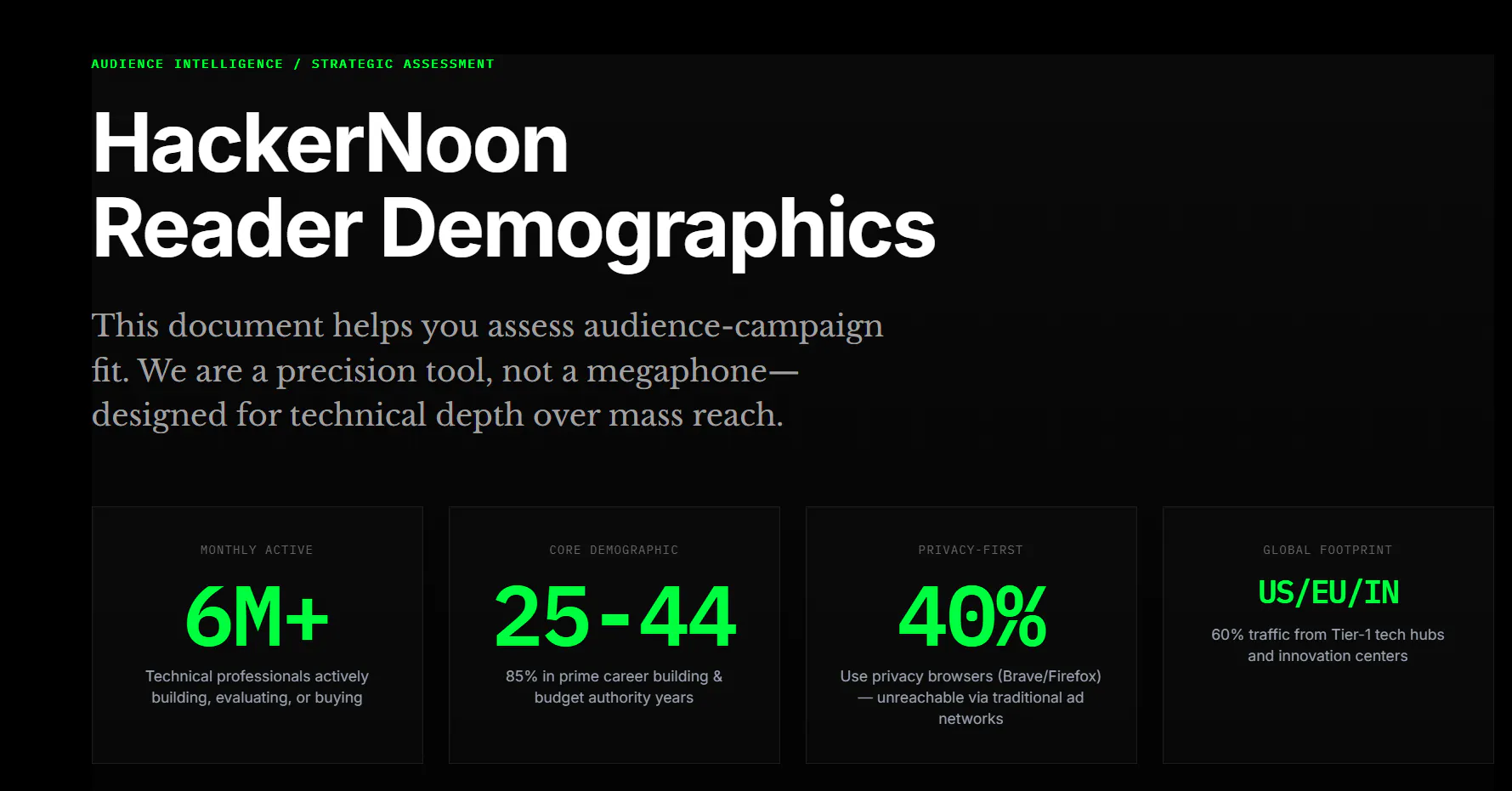
6M+ monthly active readers, 85% aged 25–44, with roughly 25% holding director-level roles or above. These are people with both context and responsibility — they've built things, worked with tools, and developed opinions. They're not looking for introductions; they're looking for clarity, relevance, and practical value.

Global Footprint, High-Value Hubs
60% of readers come from the US, EU, and India. US and European readers tend to engage with architectural content, vendor comparisons, and security topics tied to longer decision cycles. In India, engagement skews toward tutorials and implementation content, reflecting earlier-stage exploration.

An Active, Contributing Audience
67% are active GitHub contributors, and 108K are published technical writers on the platform. Most readers are building, testing, and applying what they learn, not just consuming content passively. Many are also capable of producing similar content themselves, which shapes how critically they engage with what they read.

Privacy-First by Default
40% use privacy-first browsers like Brave, Firefox, or Tor, which limits traditional ad reach. Content becomes one of the few reliable ways to reach this segment of the audience.
How Attention Works at HackerNoon
Readers make a quick decision at the start, looking for signs that content is credible and worth continuing. When those signals are present, they follow the argument through most of the article, comparing what they read against their own experience. At some point, reading shifts into evaluation: is this useful, is the tool worth trying, does this fit my context? That's where content begins to influence real decisions.
Scroll depth reflects this: around 72% of readers go through more than three quarters of an article. The behavior is linear and focused, closer to how people read documentation or research than how they scan a social feed.
Articles that hold attention tend to be grounded in experience, structured around clear reasoning, and transparent about trade-offs. Content that relies on abstract frameworks without evidence loses momentum quickly — this audience can tell.
Ready to reach them?